

Across different fields and industries, SSBM Geneva alumni are demonstrating how advanced academic research can translate into real-world impact. Their work highlights a shared theme: leadership today is not just about expertise, but about applying knowledge to solve meaningful problems in education, energy, and human performance.
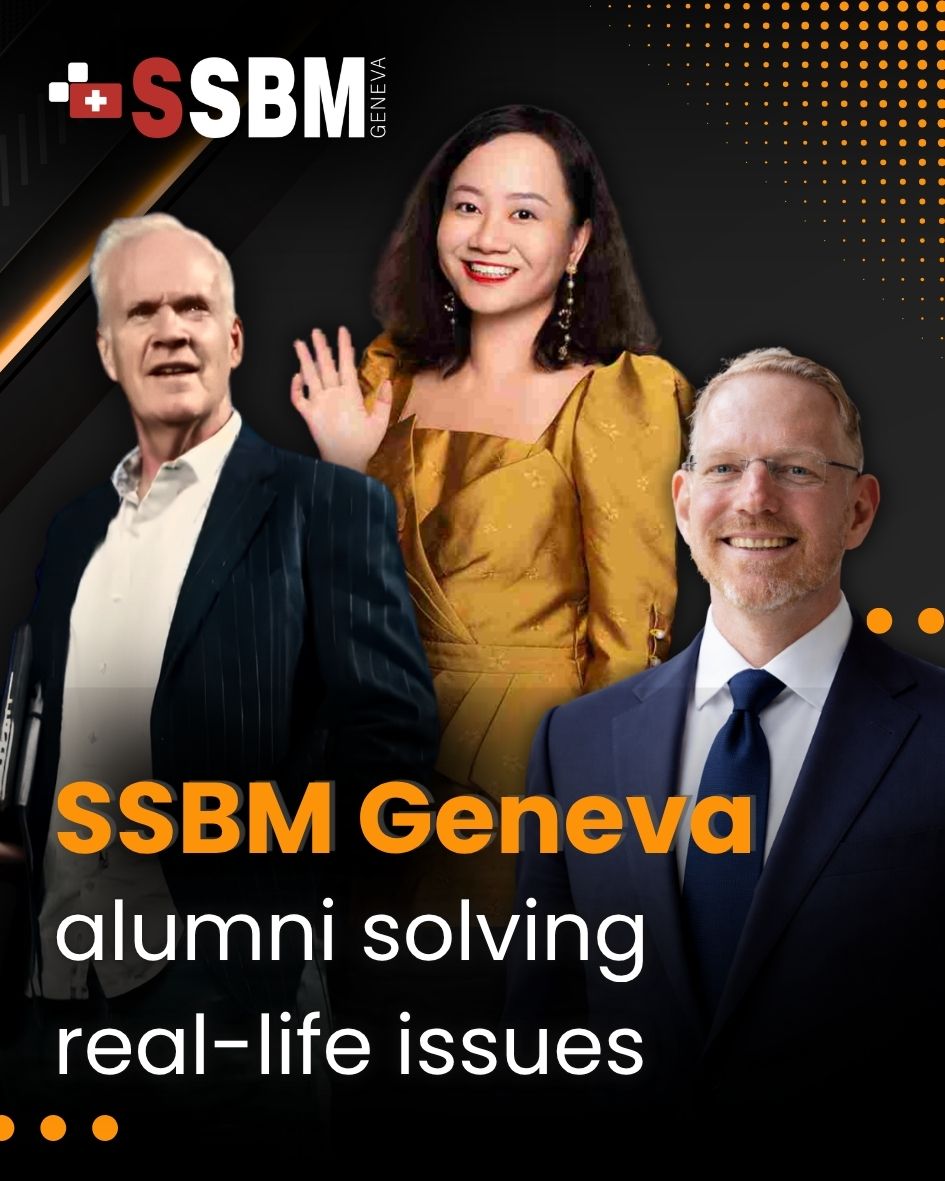
Dr. Felicia Pham founded Sunwah Education with a clear mission: to help Vietnamese learners move beyond learning English as a subject and instead develop it as a tool for global participation.
Her work focuses on building an integrated learning ecosystem that develops not only language proficiency, but also academic readiness, leadership capacity, and cross-cultural confidence. Rather than treating “international standards” as an abstract goal, she has helped redefine them as measurable, trainable outcomes.
Through this approach, students are equipped to communicate clearly, think structurally, and operate confidently in global environments. The broader impact extends beyond individual learners, contributing to a generation better prepared to participate in international education and global careers.
In the field of energy systems and industrial transformation, Dr. Pim Reuderink works at the intersection of engineering, policy, and sustainability.
Dr. Reuderink is turning the overwhelming challenge of climate change into real, workable solutions. He is actively solving some of the hardest, most urgent problems of the energy transition by turning complex technical and policy barriers into real, deployable solutions that help industries cut emissions while staying safe, reliable, and economically viable.
As Regional Technical Manager at Bureau Veritas, he is involved in offshore renewable energy, hydrogen systems, and advanced nuclear technologies across the Nordic and North Sea region. His doctoral research at SSBM Geneva strengthened his ability to translate complex techno-economic challenges into structured frameworks that can inform both industry decisions and policy development.
Beyond his professional role, his contributions as a Chartered Scientist and European Engineer reflect a commitment to advancing technical standards and transitioning engineering practices. His work supports safer, more efficient, and more coordinated pathways toward a low-carbon energy future, a challenge that requires both technical depth and strategic clarity.
Dr. Mike Conway’s work directly solves the everyday but deeply costly problem of mental overload. He is giving people and teams practical tools to regain focus, think clearly under pressure, and work with greater efficiency in environments that would otherwise drain their performance.
His experience in elite sport and high-demand performance environments helped him develop a practical solution to a common problem in modern organisations: people and teams losing time and focus due to mental overload, inefficient working habits, and a lack of structured thinking systems.
To address this, he created and tested an integrated mindset learning program called “Mindzen XV”, delivered through a virtual environment in collaboration with organisations such as Nestlé and ASM Global. The program is designed to help individuals organise their thinking, improve decision-making, and work more efficiently under pressure. Building on these findings, “Mindzen XV” has been further developed into a scalable program supported by an AI coaching system and a digital app that helps users apply the mindset tools in their daily work.
A key finding of his work showed that participants, on average, freed up around four additional hours per week by developing an integrated mindset approach. Since completing his doctorate, this research has evolved into the “Mindzen XV” program, now enhanced with an AI coaching system and a digital app to support ongoing development.
Dr. Conway recently held a guest lecture at SSBM Geneva offering students valuable insights into how frameworks for human behavior can enhance managerial decision-making in AI-driven environments. Find out more about his lecture here.
Across disciplines, a clear pattern emerges in how contemporary doctoral research is evolving: academic insight is increasingly being designed for application, not just theory. The most meaningful contributions today are those that move beyond publication and into practice, therefore shaping systems, organisations, and behaviours in ways that create measurable improvement in real-world contexts.
Whether in education, engineering, energy systems, or human performance, the emphasis is shifting toward translating knowledge into frameworks, tools, and methodologies that can be implemented at scale. This applied approach ensures that research does not remain confined to academic settings, but instead becomes a driving force for innovation, efficiency, and social progress across industries and communities.
As challenges across industries become more interdependent, the demand for applied, systems-level thinking will only grow. What stands out from these examples is not only the strength of individual research contributions but the direction they point to: a future where education, innovation, and leadership are measured by their capacity to create lasting, practical value beyond the academic environment.