

Written by Dino Kolak, Chief Operating Officer at SSBM Geneva
Recently, I watched an interview with Elon Musk in which he said that money may no longer be important by 2036.
At first, it sounds like another futuristic prediction. But behind that statement lies a much more interesting question.
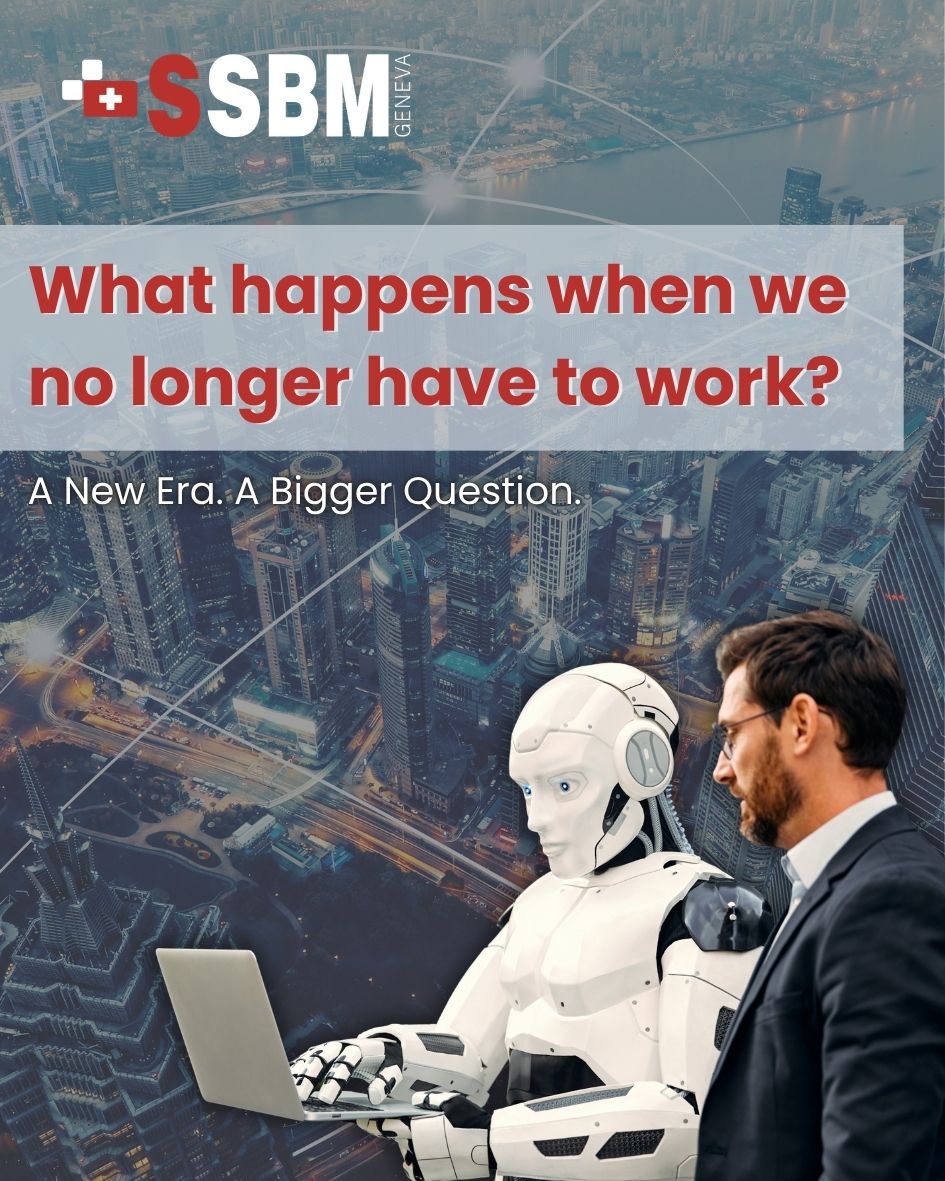
What happens if technology becomes so productive that human labour is no longer necessary for most of what we need?
Money exists largely because resources, products and services are limited. We work, earn money and use it to pay for food, housing, transportation, education, travel and almost everything else.
But imagine a world in which artificial intelligence performs a large share of intellectual work, while advanced robots take over much of the physical work.
AI can already write software, analyse data, create marketing campaigns, translate documents, build financial models and assist with legal work. What is still missing at scale is the physical component.
That is where robotics comes in.
If advanced artificial intelligence is combined with millions of capable robots, we are no longer talking only about automating individual jobs.
We are talking about a different production system.
Today, most people organise a large part of their lives around work.
We work to earn money. We use that money to pay for our lives. Then we try to use whatever time remains for family, friends, hobbies and ourselves.
If machines eventually become capable of producing a significant share of what society needs, the relationship between work, income and survival could begin to change.
That does not mean people will stop doing things.
Someone will still want to build a company. Someone will want to teach, write, make films, play football or create something with their own hands, even if a machine could do it better.
The difference is that people may no longer have to work simply to survive.
And that would change much more than the labour market.
For a long time, we have connected personal value with economic output.
How much do you earn? What position do you hold? How successful are you? What skills do you have that others are willing to pay for?
But what happens when AI becomes better than us at many of the things for which we are currently rewarded?
What if AI can write a better report, analyse more data or create a business plan faster than any individual person?
We may have to rethink what it means to be valuable.
And that has major implications for education.
If information becomes almost free, what is education for?
For a long time, one of the main roles of education was to transfer knowledge.
The professor teaches. The student listens. The student studies. The student takes an exam and receives a degree.
That model made a great deal of sense in a world where access to high-quality information was limited.
Today, that is no longer the case.
If I want to understand financial analysis, AI can explain it to me. If I want to learn the basics of marketing or coding, I can get help in seconds.
Information is becoming cheaper. Judgment is not.
That means the future value of a university cannot be based only on providing information.
Education will increasingly need to focus on developing the ability to think critically, solve complex problems, make decisions, question assumptions, work with others and apply knowledge in real situations.
A degree will still have value.
But its value will increasingly come not simply from the amount of information someone has received, but from the capabilities they have developed through the educational process.
The same logic applies to business education.
If AI can create a financial analysis, marketing strategy or business plan in a matter of minutes, that does not mean understanding finance, marketing or strategy becomes less important.
Perhaps the opposite is true.
The easier it becomes to produce an answer, the more important it becomes to know whether that answer makes sense.
Someone still needs to challenge the assumptions, understand the market and the organisation, evaluate the risks, decide which course of action is most appropriate and take responsibility for the decision.
That is why the value of an MBA will increasingly come not from teaching tasks that AI can help perform, but from developing the ability to understand complex business situations, connect different areas of business, think critically, make strategic decisions and lead people.
The same applies to the DBA.
AI can help find literature, analyse data and structure information. But research is not simply about processing information.
It is about identifying an important problem, asking the right question, choosing the appropriate methodology and creating something that contributes to knowledge and practice.
The more information we have, the more important it becomes to know which information actually matters.
The more AI can produce, the more important it becomes to know what should be produced in the first place.
AI will not only change how people learn.
It will also change why people go to university.
The traditional career model is relatively simple:
University → first job → experience → senior position → management → executive role.
But if technology changes rapidly, it is difficult to expect that one degree or one set of skills will be enough for an entire career.
People will have to continue learning throughout their lives, not necessarily because they need more degrees, but because the knowledge and tools they use will change much faster than before.
One of the most important professional capabilities of the future may therefore be adaptability.
The ability to learn, unlearn and learn again.
And then we come back to money
If AI and robotics eventually become capable of producing a large share of what people need, the role of money becomes more complicated.
Money may not disappear.
Because even in a world of enormous technological abundance, some things will remain limited.
Land. Time. Attention. Location.
Technology may make it possible to build millions of homes, but everyone cannot own the same house overlooking the sea.
AI may make many services almost free, but it cannot create more hours in another person’s day.
So perhaps the more important question is not whether money will disappear.
Perhaps it is this:
If companies own the robots, companies receive their output.
If citizens own part of that infrastructure, citizens can share in the value it creates.
If governments own it, governments influence how that production is distributed.
Technology itself does not answer that question.
We could have a world of extraordinary abundance and still have a very high concentration of ownership.
AI could help build a million homes. But who owns the land?
AI could produce almost unlimited digital content. But who controls the platforms through which that content is distributed?
Those questions may ultimately become more important than the technology itself.
This may be the most interesting question of all.
Because work gives people much more than money.
It can provide identity, status, purpose, social interaction, achievement and a sense of contribution.
If technology reduces the amount of human labour society requires, we will have to find other ways to provide some of these things.
The difficult question may not be how to provide people with food or products.
It may be how to provide meaning, purpose and a reason to get up in the morning.
If AI can write a better article than I can, I may still want to write my own.
If a robot can perform better physically, people will still want to play sport.
The value of doing something does not disappear simply because a machine can do it better.
Perhaps one of the biggest changes of the AI era will be separating human value from economic value.
The real AI question
The AI revolution is not only a technology story.
It is a story about education, work, business, economics, society and human purpose.
Universities will remain.
Jobs will remain.
Money will probably remain.
But none of them may look exactly the way they do today.
And that is why perhaps the most important question is not:
The more important question may be:
What will we choose to do with our time, knowledge and opportunities when machines start doing more and more of the things we currently do?
We do not have the answer yet.
But it is probably time we started asking the question seriously.