

Dr. Khulan van Twist, from Mongolia, is an international sustainability and leadership expert whose career spans engineering, business, governance, and systems change across Switzerland, Mongolia, and Singapore. As an alumna of SSBM Geneva’s DBA program, she has combined academic research with practical leadership to explore how organizations can navigate complexity, build resilience, and create lasting impact.
She shared how her DBA journey has shaped her approach to leadership, the frameworks she applies in her work today, and her advice for professionals seeking to combine business excellence with purpose-driven impact.
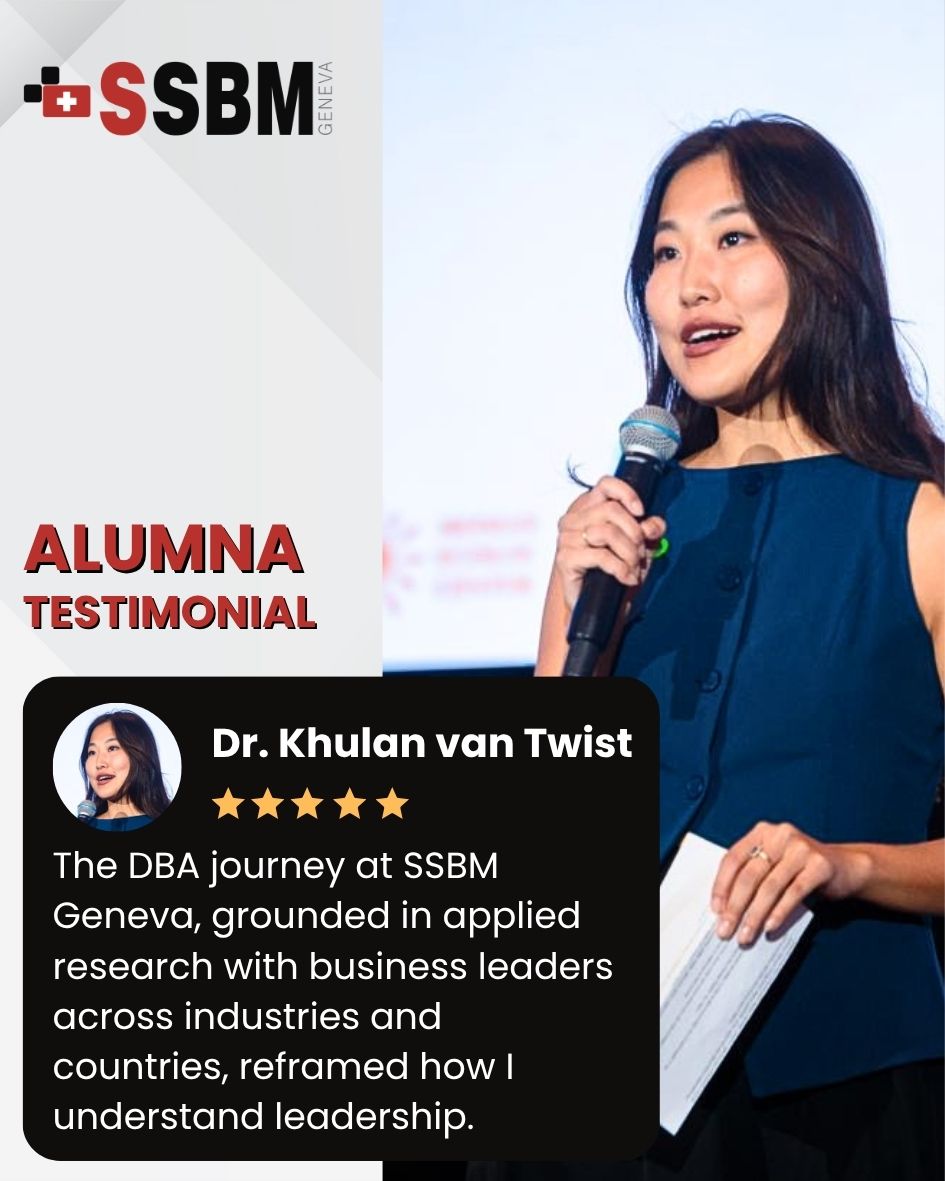
The DBA journey, grounded in applied research with business leaders across industries and countries, fundamentally reframed how I understand leadership. I came in with a background spanning computer engineering, business, and sustainability practice across Switzerland, Mongolia, and Singapore, and a genuine curiosity that traditional leadership models may be missing something, especially in a world where rapid, compounding uncertainty has become the norm.
The research explored and confirmed it. Through interviews with business leaders navigating what scholars call a polycrisis (overlapping climate, geopolitical, technological, and institutional disruptions), I found that the most effective leaders were not the most authoritative ones. They were the most reflective, relational, and adaptive.
What I ultimately defined as responsible-resilient leadership is the capacity to make values-guided decisions that maintain stakeholder trust and enable organizational adaptation under systemic disruption. This has sharpened how I approach every role I hold: from my work at Caux Initiatives of Change and Our Impact Mongolia, to my board responsibilities at Educators Lab, Eiger Institute, and Peregrine Global Services. Complex challenges require trust, collaboration, and the willingness to lead from within and across systems.
The most tangible contribution is the ROOT-to-FRUIT Model, which describes leadership development as an eight-stage cycle: four stages of inner root work and four of outer practice. The core finding it captures is that meaningful change in leadership behaviour takes years, not weeks. The shortest cycle in my data was eighteen months; the longest was eight years. Alongside the model, I apply what I call the formal-informal-inner development triangle. Formal programmes inspire and shared vocabulary. Informal networks, including mentors, peers, and alumni communities, sustain developmental momentum. Inner practice creates the reflective infrastructure that makes the other two generative.
I draw on this constantly: in how I design partnerships, structure governance, and support leaders navigating complexity. Strategy and outcomes matter, but so do relationships, trust, and the underlying conditions that allow people to actually grow.
The DBA gave me a stronger applied theoretical foundation, built through direct research with business leaders and grounded in my years of work on systems change and behavioural change, for challenges I was already encountering in climate action, sustainability, and responsible leadership. It also sharpened a lens I now apply everywhere: the gap between reflection and action. Many leaders gain insight. Far fewer translate it into sustained behavioural or organizational change. My research named this the translation gap, and it has become central to how I evaluate initiatives, design programmes, and assess impact.
Going forward, I expect this to influence how I support leaders, contribute to governance, and build collaborative structures like the Caux Collaboration Hub that help good intentions actually move. I am less interested in what leaders know than in the conditions that allow them to act consistently over time.
Yes, and the shift is less about tools than about posture. Earlier in my career, I moved quickly from problem to solution. Now I first ask: what is the wider system producing this challenge? My research showed that most leadership difficulties are symptoms of deeper, interconnected dynamics. In a polycrisis environment, treating them in isolation rarely works.
My research also revealed something counterintuitive: disruption does not automatically create transformation. Well-prepared organizations often experience crisis as confirmation of existing strategy rather than a catalyst for change. That finding complicates the standard disruption-as-opportunity narrative and makes me more careful about assuming urgency alone could drive meaningful change.
Today I approach challenges with more patience, curiosity, and humility. Less “How do we solve this?” and more “What conditions need to exist for lasting change to become possible?”
Start by letting go of the idea that purpose and performance are in tension. My own path, from computer engineering in Singapore to business in Switzerland to climate action, governance, and leadership development, has shown me they reinforce each other when the conditions are right.
Cultivate systems thinking. Learn to see the structures producing the outcomes, not just the outcomes themselves. Build relationships across sectors, disciplines, and cultures. The most resilient leaders in my research drew strength from diverse, informal networks, not only formal credentials. Invest in your inner development as seriously as your technical skills. And accept that meaningful impact unfolds on a seasonal timescale, not a quarterly one. The leaders who create lasting change are not those with the most urgency. They are those with the deepest roots.
We're celebrating MBA Month! For a limited time, receive 15% off tuition on all Online MBA programs.
This offer is valid until the end of October.