

Article by Professor Dario Silić, PhD.
The FIFA World Cup always sells two powerful dreams: one emotional, filled with passion, unity, global attention, and one financial, promising growth, jobs, tourism, and prosperity. But when we move beyond the excitement and ask a more rigorous question, if it is actually profitable, the answer becomes far more complex and intellectually interesting.
From a strict financial perspective, the World Cup is rarely a straightforward “profit-making” investment for host countries. Direct revenues are heavily captured by FIFA through broadcasting and commercial rights, while hosts absorb most of the operational and political burden. However, when profitability is viewed through a broader macroeconomic lens, such as GDP growth, tourism inflows, labor income, tax revenues, and global branding, the picture changes significantly.
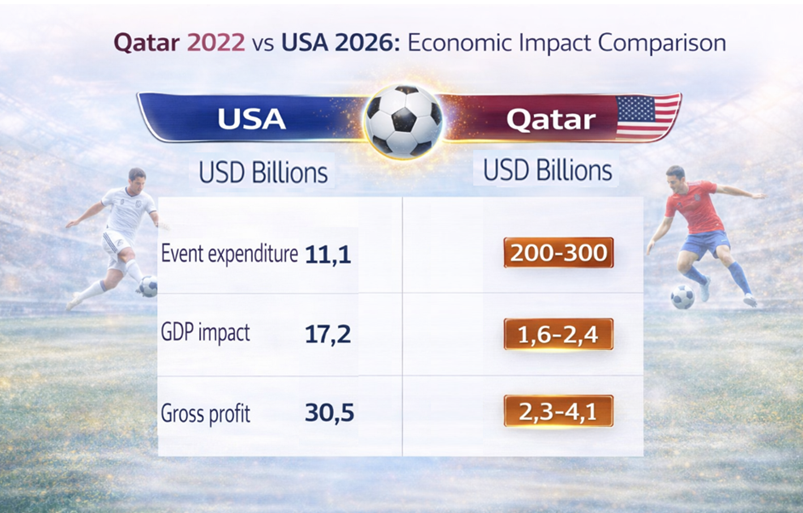
This is where the comparison between USA 2026 and Qatar 2022 becomes crucial. Qatar invested an estimated $200–300 billion, largely building infrastructure from scratch as part of a long-term national transformation strategy. While it achieved global visibility and prestige, the financial return remains highly debated due to the sheer scale of investment and uncertain long-term utilization. The United States, by contrast, is playing a completely different economic game. Instead of building new infrastructure, it is monetizing existing assets: stadiums, airports, hotels, and globally recognized cities. This dramatically lowers financial risk and shifts the model from “nation-building” to “value extraction”.
Ultimately, the key lesson is this: the World Cup is not about short-term profit—it is about long-term value creation. Qatar used it as a tool for global visibility and national transformation, while the United States is leveraging it as a platform for economic optimization and global influence.
The deeper insight for business leaders and policymakers is clear: the smartest strategies are not about spending more, but about leveraging what already exists to create sustainable value. For future students of SSBM Geneva, that is perhaps the deepest lesson. Leadership in the twenty-first century is not only about balance sheets and hard power. It is about understanding how economics, branding, diplomacy, mobility, and social impact interact. The smartest nations do not merely spend; they create value. They not only project force; they create attraction. That is why, in both financial and civilizational terms, major sporting events are a far better instrument than wars.
The full analysis in the article of Prof. Dario Silić dives deeper into the economics, risks, political implications, and strategic lessons behind World Cup hosting, and why major global events may be one of the most powerful tools of modern economic diplomacy.
The FIFA World Cup always sells two dreams at once. The first is emotional: flags, anthems, sold-out stadiums, and a rare month in which the world appears to speak one language. The second is financial: tourists arrive, hotels fill, tax receipts rise, restaurants celebrate, and politicians promise that sport will do what policy often struggles to do—create growth, jobs, attention, and optimism. But the 2026 FIFA World Cup in the United States deserves a harder question than the marketing slogans usually allow: Is it really profitable?
My answer, as a professor of finance at the Swiss School of Business and Management Geneva (SSBM), is deliberately provocative. If we define profitability as a narrow cash-on-cash return to the public sector, the answer is less impressive than the headlines suggest. If we define profitability more broadly—through GDP growth, job creation, tax revenue, tourism, infrastructure utilization, and international image-building—then the answer becomes much more favorable for the United States than it was for Qatar in 2022. In other words, 2026 may not be a perfect financial “deal,” but it can still be a highly rational national investment. [1][2]
The first rule in analyzing sports mega-events is simple: never compare host countries as if they were playing the same economic game.
Qatar hosted the 2022 FIFA World Cup largely as a state-branding project. According to the IMF, the decade-long preparation for Qatar 2022 involved an estimated USD 200–300 billion of investment, much of it tied to broader national development and diversification plans rather than stadium costs alone. FIFA later described Qatar 2022 as the most profitable World Cup in FIFA history, generating USD 6.314 billion in revenue in the 2019–2022 cycle, including USD 929 million from ticketing and hospitality. That is the brutal arithmetic of World Cups: the host absorbs major costs and political risk, while FIFA captures a very large share of the direct commercial upside. [2][6]
|
Dimension |
USA 2026 |
Qatar 2022 |
|
Hosting model |
Leverage existing stadiums, airports, hotels, and city brands |
Large state-led buildout tied to long-term nation-branding and diversification |
|
Headline spending frame |
USD 11.1B U.S. event-related expenditure in 2026 impact study |
IMF cites a decade-long preparation estimate of roughly USD 200–300B |
|
Direct tournament commercial upside |
Large portions still captured by FIFA and related rights-holders |
FIFA explicitly called Qatar 2022 the most profitable World Cup in its history |
|
Key risk |
Operational complexity, visas, transport, public narrative |
Capital recovery, post-event utilization, and reputational controversy |
|
Strategic upside |
Tourism, tax revenue, labor income, soft power, city branding |
Global visibility, infrastructure legacy, diplomatic positioning |
The United States enters 2026 with a fundamentally different cost structure. It already has major stadiums, airports, hospitality capacity, highways, media infrastructure, and globally known cities. That means the American version of World Cup economics is not based on building a country for football; it is based on monetizing an ecosystem that largely already exists.
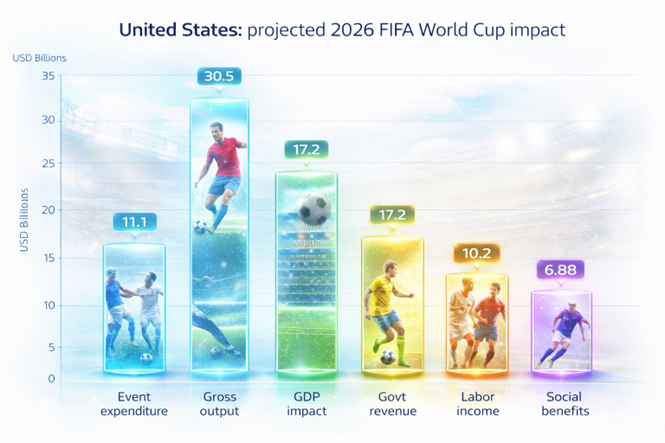
That is why the March 2025 FIFA–WTO–GoalEconomy impact analysis matters. It estimates that the FIFA World Cup 2026 could generate USD 30.5 billion in gross output[1] in the United States against global USD 80.1 billion, USD 17.2 billion in GDP, USD 10.2 billion in labor income, around 184,679 full-time-equivalent jobs, and USD 3.4 billion in government revenue. It also estimates USD 6.88 billion in extra-financial social benefits for the United States, with a social return on investment of 4.03.
The social return on investment (SROI) of 4.03 means that for every $1 of economic cost[2] associated with the World Cup in the USA, society is estimated to receive $4.03 of social value.
So the logic is:
SROI = Total social benefits / Economic cost = 6.88 / 1.71 ≈ 4.03
What counts as “social benefits” here is broader than profit. The report says these benefits include Tourism benefits, Sport benefits and Entertainment benefits.
Event-related expenditure for the United States is projected at USD 11.1 billion out of the tournament’s broader $13.9 billion total event-related expenditure across Canada, Mexico, and the U.S., driven heavily by tourism and FIFA-related spending rather than by vast new construction. [1]
For the U.S., that $11.1 billion [3] includes mainly:
This is where many public debates become intellectually lazy. Gross output is not profit. GDP is not profit. Even tax revenue is not profit in the corporate-finance sense. These are impact measures, not equivalent to free cash flow.
When a study says the United States may see USD 17.2 billion in GDP impact, that does not mean Washington books USD 17.2 billion in net gain. It means economic activity expands through tourism, accommodation, food services, retail, transportation, real estate, and linked supply chains. According to the 2025 impact study, accommodation and food, real estate, and wholesale and retail are among the biggest beneficiaries of the World Cup shock in the U.S. economy. [1]
So, is the event “profitable” for America? Strictly speaking, not in the simplistic way many social-media posts will claim. But the event does appear capable of generating a strong macroeconomic and fiscal impulse with much lower capital exposure than a state-led buildout model such as Qatar’s.
The most immediate economic logic of World Cup 2026 lies in tourism. The FIFA–WTO study estimates USD 7.5 billion in tournament-related tourism expenditure across the competition, using assumptions based on 6.52 million total stadium attendance, 40% foreign attendance, average tourist spending of USD 416 per day, and an average stay of 12 days. For the U.S. alone, the report attributes USD 6.4 billion of anticipated tourist spending as part of the country’s USD 11.1 billion expenditure profile. [1]
Tourism money is fast money. It hits hotels, restaurants, domestic transport, entertainment venues, retailers, and city tax bases quickly. It also has a demonstration effect: cities such as Miami, Los Angeles, and New York are not only selling tickets to matches; they are selling future holidays, future conventions, future investment attention, and a refreshed global brand.
That is why the event’s profitability should not be judged only by what happens during the 39-day tournament window from 11 June to 19 July 2026. The more strategic lens is whether the event creates lasting tourism and business spillovers after the final whistle.
The 2025 impact analysis goes beyond classic economics and assigns U.S. social benefits of USD 6.88 billion, including tourism consumer surplus, sports-related health and social gains, and entertainment benefits. It uses a five-year horizon and a 5% discount rate, producing a stated U.S. social return on investment of 4.03. [1]
Of course, these models depend on assumptions and must be treated carefully. Yet the broader point remains valid: sport is not only a spending event; it is a social technology. It can generate gains in physical activity, community identity, civic participation, international connectedness, and public morale. That is precisely why major tournaments matter far beyond ticket receipts.
Yes—potentially, but not automatically.
The White House established a FIFA World Cup 2026 Task Force in March 2025 to coordinate federal efforts related to the 2025 Club World Cup and the 2026 World Cup. FIFA President Gianni Infantino publicly thanked President Trump for supporting that initiative. Politically, this gives Trump a visible international platform linked to hospitality, border management, aviation readiness, security coordination, and economic messaging. [3][4][5]
If the event is operationally smooth, if fans travel without chaos, if airports function, if security works, and if the economic story is positive, then the administration will inevitably try to frame the tournament as proof that America can still host the world at scale. That is far more attractive imagery than permanent headlines about conflict, escalation, or geopolitical disorder.
But the World Cup can also damage an administration’s image if visa barriers, travel bottlenecks, public-safety issues, or anti-visitor rhetoric dominate the story. A tournament of this size is a reputational amplifier. It magnifies competence—and incompetence.
So the precise answer is this: the 2026 World Cup could improve Trump’s image if his administration treats the tournament as a diplomacy-and-growth project rather than merely a political stage set. That is not ideology. That is risk management.
Here I want to be direct. Wars destroy capital, destroy trust, destroy infrastructure, and destroy human lives. Even when military spending boosts certain sectors in the short term, it rarely produces the broad-based tourism, cultural attraction, civic pride, and international goodwill that a successful global sporting event can create. War may enrich contractors; sport can energize cities.
That is not a sentimental statement. It is a strategic one. A country that wants long-term prosperity should prefer engines of attraction over engines of destruction. The World Cup is not a substitute for foreign policy, of course. But it is a far better instrument of soft power. It brings visitors instead of refugees, cameras instead of missiles, and consumer demand instead of reconstruction bills.
For the United States, that distinction is decisive. Hosting the world through sport is economically and morally superior to projecting power through conflict. One creates networks, business, memories, and repeat visits. The other creates fear, volatility, fiscal pressure, and reputational damage.
Let us say what many analysts avoid saying clearly: Qatar 2022 proved that World Cups can be spectacular without being financially rational for the host country.
Qatar gained prestige, infrastructure, visibility, and diplomatic attention. It also accelerated parts of its national diversification strategy. But the likely host-side financial return remained highly debatable because the capital scale was extraordinary, much of the direct commercial revenue belonged to FIFA, and the domestic utilization challenge after the tournament was always going to be significant for a small country. [2][6]
Most American stadiums were already economically embedded. The challenge is not post-event emptiness; it is operational coordination, political tone, and the conversion of temporary global attention into sustained economic value. That is a far healthier problem to have.
So, is the 2026 FIFA World Cup in the United States really profitable?
My answer is yes—but with an asterisk big enough to deserve its own stadium.
Yes, it is likely to be profitable enough in macroeconomic, tourism, labor, tax, and soft-power terms to justify the event—especially because the United States is using pre-existing infrastructure and globally recognized host cities. [1][5]
No, it should not be sold dishonestly as a simple accounting windfall or as free money falling from the sky.
The serious conclusion is this. The event is more economically credible for the United States than Qatar 2022 was for Qatar. It is more likely to create distributed benefits across tourism, services, labor income, and tax receipts. It can improve America’s global image if it is run competently. It can also help President Trump politically, but only if he is associated with openness, competence, security, and welcome, not division. Above all, it demonstrates that sport is one of the smartest tools of modern international influence.
Even if one of the key messages of FIFA for accepting the World Cup in the USA/Canada/Mexico was to promote sport in North America, it is undeniable that the international sporting events bridge societal divides and bring people together across borders. These events also encourage children to take up sport.
However, as professor in Financial management in SSBM Geneva I must conclude and highlight the fact that even the profitability was not there for Qatar on short et middle term basis, with high uncertainties for long term profitability, what is sure is that FIFA will earn much more for commercial deals, ie an unprecedented $7.5bn in revenue through four years of commercial deals tied to the 2022 World Cup in Qatar while we shall see the results for World cup in North America where FIFA will probably earn less.
At the same time, Qatar realized much more than the USA in investments ($229bn in Investments), which will not be reimbursed with Cash Flows resulting from such investments in the next few generations of the population.
However, for a host country, Qatar, a World Cup was always about pride and honour and publicity, more than it was ever about making money and profits, as many countries and financial experts as I would be looking for before engagement of any such huge investments.
For future students of SSBM Geneva, that is perhaps the deepest lesson. Leadership in the twenty-first century is not only about balance sheets and hard power. It is about understanding how economics, branding, diplomacy, mobility, and social impact interact. The smartest nations do not merely spend; they create value. They not only project force; they create attraction.
That is why, in both financial and civilizational terms, major sporting events are a far better instrument than wars.
Sources:
[1] FIFA / WTO / GoalEconomy, FIFA World Cup 2026: Socioeconomic Impact Analysis, March 2025.
[2] FIFA Annual Report 2022 and 2019–2022 revenue / financial highlights pages, including statement that Qatar 2022 was the most profitable World Cup in FIFA history and that World Cup-related rights generated USD 6.314 billion in the cycle.
[3] The White House, 'Establishing the White House Task Force on the FIFA World Cup 2026,' 7 March 2025.
[4] The White House, FIFA World Cup 2026 Task Force page.
[5] FIFA media release, 4 April 2025, on FIFA–WTO studies estimating the socioeconomic impact of the 2025 Club World Cup and 2026 World Cup in the United States and globally.
[6] IMF, '2022 FIFA World Cup: Economic Impact on Qatar and Regional Spillovers,' noting estimated preparation spending of roughly USD 200–300 billion over a decade and positioning the tournament within Qatar’s diversification strategy.
We're celebrating MBA Month! For a limited time, receive 15% off tuition on all Online MBA programs.
This offer is valid until the end of October.