

The traditional idea of education as something that happens early in life is changing. As industries evolve, career paths become less linear, and employers look for increasingly adaptable professionals, learning is becoming a continuous part of career development.
For today’s professionals, gaining a degree or completing a qualification is no longer necessarily the end of the learning journey. It can be the foundation for a career built around continuous development.
This shift is making lifelong learning one of the most valuable career advantages of the modern workplace.
For decades, the typical career path was relatively straightforward: complete your education, enter a profession, gain experience, and gradually progress into more senior positions. That model is becoming less relevant. Professionals today may change industries, move into international roles, transition from specialist positions into management, or build careers that combine several areas of expertise. As responsibilities change, the skills required to succeed change with them.
Technical expertise remains important, but career progression increasingly requires professionals to understand the bigger picture: how organizations operate, how teams are managed, how strategic decisions are made, and how businesses respond to changing markets. This is where continuous learning becomes particularly valuable.
Experience remains one of the most valuable assets a professional can have. But experience alone does not always provide everything needed for the next stage of a career. Lifelong learning allows professionals to combine what they have learned through experience with new concepts, frameworks and perspectives.
This can happen through professional development, executive education, certifications, specialized courses or advanced academic programs. The goal is not necessarily to collect qualifications. Instead, it is to keep developing the capabilities that matter as responsibilities evolve.
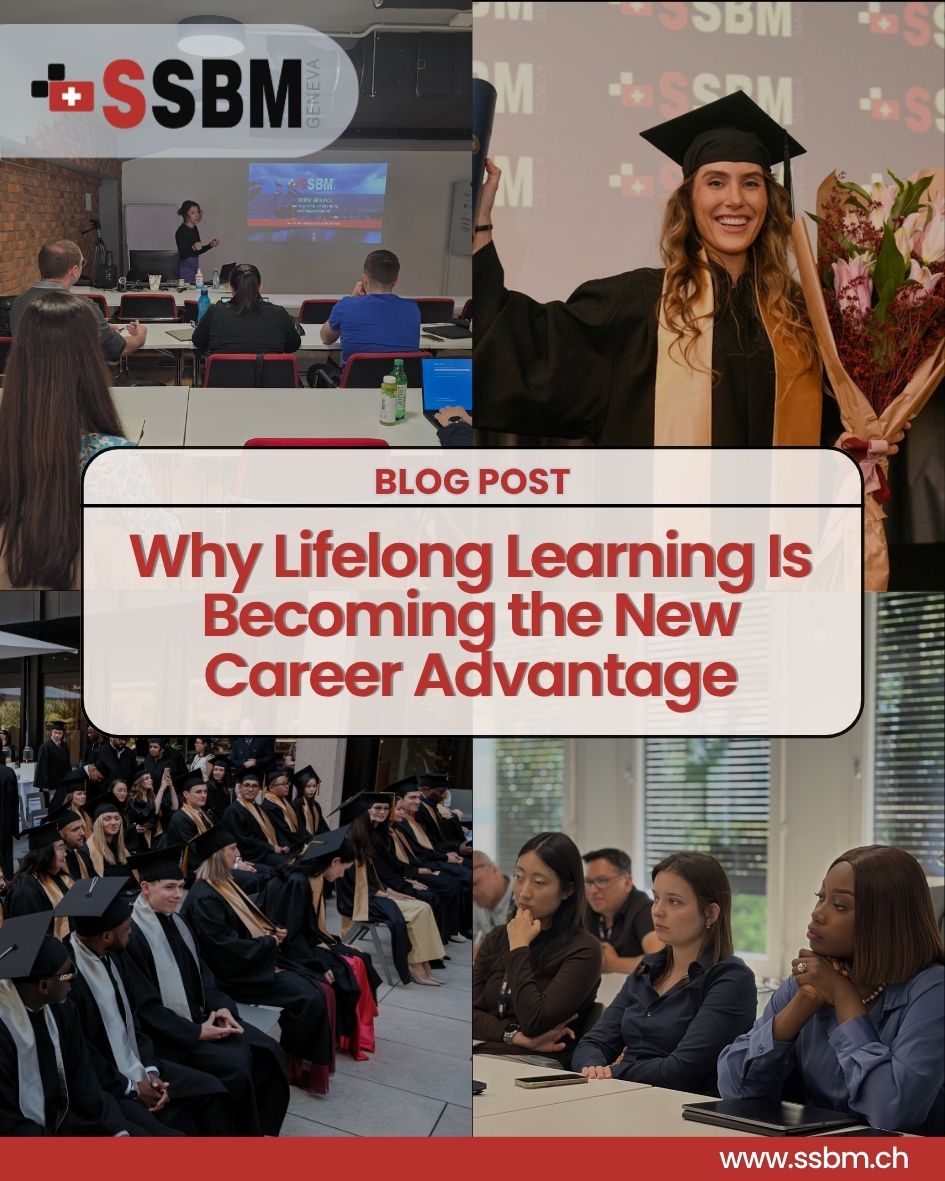
Modern managers need a combination of business knowledge and leadership capabilities. Strategic thinking, financial understanding, communication, negotiation, decision-making, leadership and international business awareness can all become increasingly important as professionals move into positions of greater responsibility. These capabilities are also highly transferable, they can help professionals move between functions, industries and markets while giving them a broader understanding of how organizations create value and respond to change.
This is one reason postgraduate business education continues to be relevant for experienced professionals.
For professionals looking to develop their management capabilities, an MBA can represent an important stage in the lifelong-learning journey. Rather than focusing on a single business function, MBA education offers a broader perspective on how organizations operate, bringing together areas such as strategy, finance, marketing, operations and leadership.
This wider understanding can be particularly valuable for professionals who are preparing to move from specialist or operational roles into management and leadership positions, as well as for those looking to transition into new areas of business. An MBA can also help professionals connect existing experience with new knowledge and perspectives, enabling a more strategic approach to business challenges.
For many professionals, lifelong learning does not stop with an MBA. As careers progress and responsibilities become more complex, some may choose to take their expertise further through doctoral-level business education. A DBA can be particularly relevant for experienced professionals who want to explore complex business challenges in greater depth while connecting research with real-world management practice. It offers an opportunity to move beyond applying established business concepts and instead investigate questions that are directly relevant to organizations, industries, and professional practice.
The value of lifelong learning extends well beyond acquiring another qualification. It encourages professionals to remain curious, challenge established assumptions and approach familiar business problems from different perspectives. These qualities can become increasingly important as professionals take on greater responsibility and encounter more complex decisions.
Continuous learning can also help professionals prepare for opportunities before they arise: someone who develops leadership capabilities before moving into a senior management position may be better equipped to take on that responsibility, while a professional who broadens their understanding of business may be better positioned to transition from a specialist role into a strategic one.
The concept of lifelong learning is closely aligned with the different stages of a modern business career. Professionals do not necessarily need the same type of education throughout their working lives: early-career professionals may focus on establishing a strong foundation, managers may seek broader business and leadership knowledge, while experienced executives may want to develop advanced expertise and explore complex organizational challenges.
SSBM Geneva’s MBA and DBA pathways reflect these different stages of professional development. Its MBA programs provide opportunities for professionals to broaden their business knowledge, strengthen their management capabilities and prepare for greater leadership responsibilities, while its DBA programs offer experienced business professionals the opportunity to develop advanced expertise through research connected to real-world business practice. Together, these pathways illustrate how postgraduate education can remain relevant throughout a professional journey rather than being viewed as a one-time milestone.
Ultimately, this approach reflects an important reality of today’s business environment: professional development does not have to end when you start your career. It can evolve with you as your responsibilities, ambitions and the demands of the business world change.
The strongest career advantage may not be knowing everything today, but having the willingness and ability to continue learning tomorrow. As businesses evolve and professional responsibilities change, the ability to expand one’s knowledge, develop new capabilities and look at challenges from different perspectives can become increasingly valuable.
Lifelong learning provides a framework for that continuous development. Whether the next step is an MBA, a DBA, executive education or another form of professional development, continuing to learn can help professionals build careers that are not only relevant to today’s business environment but also prepared for what comes next. Education is no longer simply a stage that comes before a career; for today’s professionals, it can be an integral part of the career itself.
We're celebrating MBA Month! For a limited time, receive 15% off tuition on all Online MBA programs.
This offer is valid until the end of October.