

Mireille Serhan is a Professor of Food Engineering and Biotechnology at the University of Balamand in Lebanon, with more than two decades of experience in higher education, research, and academic leadership.
As a scientist, professor, and academic leader, she has developed a strong interest in management, leadership, and strategic decision-making, which prompted her to pursue her MBA studies at SSBM Geneva
I am a Professor of Food Engineering and Biotechnology at the University of Balamand in Lebanon, with more than two decades of experience in higher education, research, and academic leadership. I completed my PhD in France in 2008, and my career has since expanded to include program development and coordination, accreditation, team leadership, and academic administration, including currently serving as Assistant Dean and previously as Department Chair.
Management has always interested me alongside science. My academic leadership responsibilities have further developed my interest in how organizations operate, how people are led, and how strategic decisions are made. At this stage of my career, I wanted to complement my scientific foundation with an international executive and business perspective. I was already an established scientist, professor, and academic leader, and I saw the International Executive MBA as a natural extension of that journey—not replacing my professional identity, but expanding it. It is helping me connect scientific thinking with leadership, management, and entrepreneurship, while looking beyond research itself to how knowledge can create impact in organizations and in the real world.
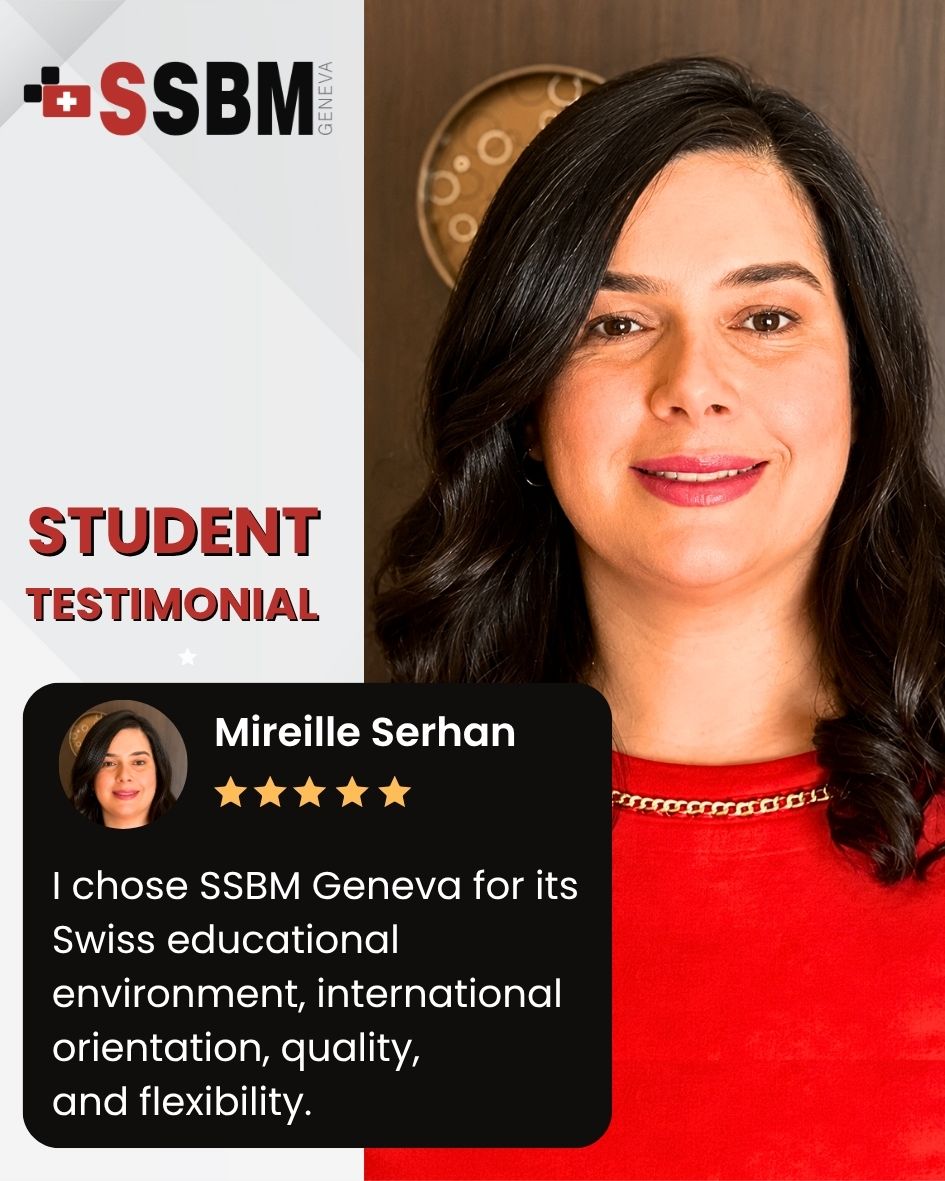
I chose SSBM Geneva for its Swiss educational environment, international orientation, quality, and flexibility. Having completed my PhD in France, I valued continuing my education within a European context and adding an international executive dimension to my professional profile.
I also greatly appreciated SSBM Geneva’s understanding of the economic challenges in Lebanon and its flexibility regarding tuition fees. Their effort to make the program financially accessible made a real difference to me and reflects something I strongly believe in as an educator: access to quality education should not be limited by challenging circumstances.
My choice also had a forward-looking dimension. I am considering establishing my own food-related business, and I wanted to acquire the skills needed to transform scientific knowledge and innovative ideas into sustainable ventures. The MBA is also opening new research directions for me at the intersection of food science and business, particularly in agribusiness, sustainability, and innovation.
Ultimately, I see this MBA as a bridge between what I have already accomplished and what I still aspire to achieve. It is about building on my scientific identity and giving me new tools to turn knowledge into strategy, innovation into opportunity, and ideas into impact.
Several courses have been particularly valuable, including strategic leadership, organizational behavior, innovation and change management, and sustainability. Their practical relevance has allowed me to look differently at situations I have encountered throughout my professional career.
Leadership has been especially meaningful because it has given me a structured framework through which to reflect on my experience leading departments, programs, accreditation processes, and academic and research teams. The program has also enriched my teaching of Food Service Management by providing new perspectives that I can bring into the classroom.
Most importantly, the MBA has changed the way I approach problems. My scientific training taught me to ask whether an idea is evidence-based and scientifically sound. I now also ask: Can it be implemented? Is it sustainable? How should it be managed? How can it create value? Combining scientific reasoning with business thinking has been one of the most rewarding aspects of the program.
Learning is an amazing journey, and academics should never fall into the trap of routine. We spend much of our careers teaching others and becoming experts in our disciplines, but we should also remain curious and willing to become students again.
For colleagues who enjoy thinking outside the box and stepping beyond their comfort zone, an MBA may definitely ring a bell.
My motivation is also deeply personal. I am a proud mother of an adolescent daughter whose curiosity, strength, and determination continually inspire me to become a better version of myself, both personally and professionally. I also want her to see that learning and personal growth never really stop.
After years of being the professor, I chose to become the student again. This experience has reminded me that academic achievement should never mark the end of our own education.
My message to fellow academics is therefore simple: remain curious, and do not be afraid to explore beyond your discipline, and keep challenging yourself in new ways. Learning has no expiration date, and sometimes the most exciting opportunities begin when we dare to become students again.